Halloween Boo Print Wrap for 40 Oz: Graphics & Crafts
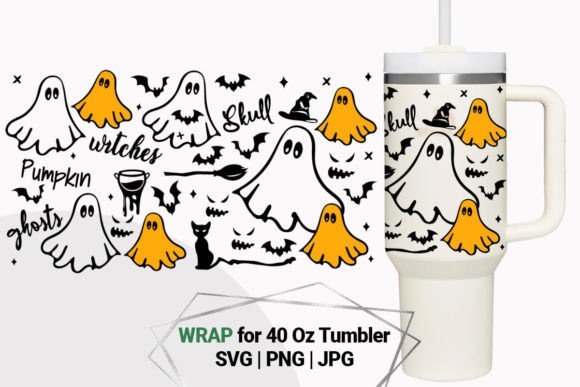
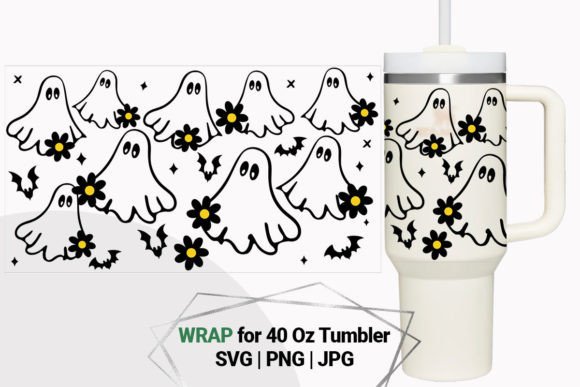
When I first opened the Halloween Boo Print Wrap for 40 Oz file set, I was looking for a seasonal asset that could expand a tumbler wrap collection without feeling overly cartoonish or cheap. The visual personality of this design sits somewhere between playful and slightly edgy — the “boo” lettering has a ghostly cutout feel, and the overall composition reads as festive but not childish. That balance matters if you’re selling to buyers who decorate their homes with a darker, contemporary Halloween aesthetic or who want tumbler accessories that still feel a little premium. The mood is playful-spooky, not horror, and that alone opens up a wide swath of customer segments: from Cricut crafters making gifts to print-on-demand sellers listing seasonal drinkware.
Before I test anything, I always check how the artwork renders across file types. This bundle includes SVG, PNG, PDF, JPEG, and EPS formats, which is exactly what I’d expect for a commercial design sold in the crafts space. The SVG opened cleanly in my design software with grouped layers, no stray nodes, and cut lines that felt intentional. For Cricut project use, that’s critical — a messy SVG can destroy a vinyl cut and waste a test blank. The PNG had true transparency at 300 DPI, so I could drop it onto mockups immediately. The PDF and EPS paths remained intact, which gives me confidence for print workflows, especially if someone wants to use the design on a larger scale like a gift bag or a sign.
Who This Design Actually Attracts
I’ve learned that digital product success often hinges on understanding the subtle buyer persona. This isn’t a fairy-tale pumpkin patch graphic. The “Boo” typography uses a slightly distressed, almost chalkboard-like treatment, and the ghost motifs feel modern and minimal. The wrap would appeal to sellers targeting a feminine Halloween crowd who still want a bit of sass, or to boutique crafters who prefer a muted, monochrome base with pops of color. I could see it working well inside a design bundle alongside other neutral-toned Halloween elements, or as a standalone printable design for a tumbler wrap collection that includes a 40 oz option — a size that’s been trending heavily in the tumbler and sublimation markets.
Testing the Asset Like a Real Seller
I approach every graphic design asset as if I’m about to publish a listing the next day. Here’s the exact sequence I go through to de-risk a product before it ever hits my shop:
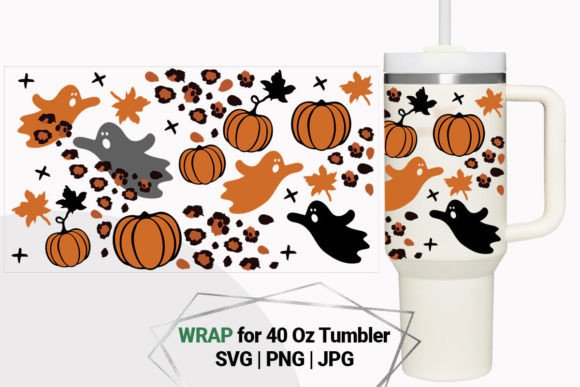
- Mockup immersion: I place the PNG on a 40 oz tumbler mockup from multiple angles. The wrap dimensions fit the standard 40 oz straight-wall template without awkward stretching — the design was clearly built with that ratio in mind. I also test on a curved mug mockup just to see if distortion breaks the composition. It held up well enough that I’d feel comfortable listing it for both straight and slightly tapered blanks.
- Thumbnail snapshot: I simulate an Etsy listing thumbnail by shrinking the mockup to 200px wide. The word “BOO” remains legible, and the ghost shapes don’t turn into unrecognizable blobs. That’s huge for click-through potential in a crowded seasonal search.
- Contrast check: I view the design on a white background, a dark charcoal background, and a transparent background. The art relies on black, white, and layered opacity, so it performs best on mid-tone or light backgrounds. On pure black, the darker ghost elements nearly vanish, which tells me I’d caution buyers if I’m selling a Sublimation design intended for dark surfaces.
- Print test: I run a test print on a standard laser printer, cut the wrap with a paper trimmer, and place it under a clear tumbler shell. Colors translated true to screen, and the linework stayed crisp. For sellers who rely on printable design files for physical products, this no-surprise output is what builds repeat customers.
- Cut simulation: I load the SVG into Cricut Design Space, resize to the exact 40 oz wrap dimensions, and preview the cut paths. I check for open paths, disconnected loops, and unnecessary complexity. The vector was clean. I’d still recommend a test cut on scrap vinyl before committing to a final product, but the file didn’t require any repair work.
Where the Halloween Boo Print Wrap Shines
This asset fits neatly into several product categories that perform well during Q3 and Q4. I’d use it without hesitation inside:
- 40 oz tumbler wraps — the primary purpose, and the sizing is accurate.
- Seasonal t-shirt graphics — the PNG and SVG can be adapted for chest prints, pocket decals, or full-back designs with a little modification.
- Mug designs — scaled down, the artwork looks crisp on 11 oz and 15 oz mug templates.
- Canva templates — adding the PNG into a frame-based template for Halloween party invitations or social media posts gives buyers a quick, polished look.
- Digital paper packs and scrapbooking kits — the isolated ghost elements can be pulled out and used as embellishments.
- Product mockup previews — the wrap itself, when photographed on a real tumbler, becomes a powerful listing image that signals a cohesive brand identity.
I also see potential for social media graphics — the vertical composition works nicely for a Pinterest pin or Instagram story, especially when paired with a handwritten font overlay for a “boo basket” promo.
Where You Need to Proceed with Care
No design is a universal Swiss Army knife. After testing, I’d be thoughtful in these scenarios:
- Tiny sticker details: The ghost eyes and some thin lettering strokes could close up if cut too small in vinyl. I’d keep the sticker size above 2.5 inches for the main wordmark.
- Overly complex layouts: If you’re combining this wrap with other overlapping elements in a Canva template, the visual hierarchy can get muddy fast. The design already has a strong focal point, so let it breathe.
- Low-resolution print products: The JPEG is high-res, but if a customer downscales carelessly for a tiny product label, the distressed edges might pixelate. Always provide usage guidance in your product description.
- Crowded thumbnails: On a search results page, a thumbnail filled with too many small elements dilutes the impact. Let the “BOO” be the hero.
- Dark background apparel: As mentioned, the design relies on transparency and light ghosting. On a black t-shirt, you’d need to invert colors or add a white underbase, which isn’t always straightforward for a new seller.
- Products requiring clean cutting lines: While the SVG is clean, detailed inner cuts on small-scale heat transfer vinyl might still require a skilled weeding hand. If you’re targeting beginners, include a note about weeding settings.
Practical Seller Notes for a Smoother Launch
I keep a running checklist whenever I bring a new commercial design into my product rotation. Here’s what I’d document for the Halloween Boo Print Wrap for 40 Oz:
- File organization: Before uploading to any marketplace, I’d group files into labeled folders: SVG, PNG transparent, PDF, JPEG, EPS. I’d also include a README with dimensions and suggested use cases. Clear packaging reduces customer confusion and refund requests.
- Font pairing guide: This design works well with a script font for a “spooky elegance” vibe, a sans serif for a modern minimalist edit, or a handwritten font for a playful loyalty card. I’d show a quick mockup of each in the listing images to demonstrate versatility.
- Commercial license verification: I always confirm the licensing terms. Since this asset is sold as a graphic design asset for commercial use, I’d check whether the license permits use on physical products for resale, print-on-demand, or digital templates. Never assume.
- Test on real mockups: I’d photograph the actual printed wrap on a 40 oz tumbler, not just rely on digital renders. Physical proof builds buyer confidence and reduces the “it didn’t look like the picture” complaints.
- Preview as a marketplace thumbnail: I’d A/B test two main thumbnail styles: one with the wrap on a white tumbler, one on a pastel Halloween-themed background. The lighter background wins for contrast.
- Check on white and dark backgrounds: I’d include both variations in the listing gallery so customers know exactly what they’re getting.
- Test print colors: I’d print on different paper stocks (matte, glossy, sticker paper) to see if the ghost opacity shifts. I’d note any adjustments in the product description.
- Verify PNG transparency: I’d open the PNG in a photo editor, place it on a colored background, and confirm there’s no white halo around the ghosts. The file passed this test.
- Inspect SVG cut quality: I’d run a test cut on medium-weight cardstock with a fine-point blade. The intricate parts held without tearing.
- Confirm file resolution: At 300 DPI, the raster files are sufficient for print up to the tumbler size. I’d note that scaling beyond 40 oz may require vector resizing via the SVG or EPS.
How This Asset Strengthens a Digital Product Collection
Over the years, I’ve noticed that print-on-demand and creative marketplace buyers often return to shops that offer design consistency. The Halloween Boo Print Wrap for 40 Oz can serve as a cornerstone piece for a seasonal product line. Pair it with coordinating tumbler wraps for 20 oz and 30 oz sizes, add a matching clipart set of ghosts, and offer a design bundle with a Canva template for party invitations. Suddenly, you’re not just selling a single wrap — you’re selling a cohesive small business branding kit that helps your customers create a unified look across their own product offerings.
For Etsy sellers and digital download creators, the perceived value of a well-organized set of related design assets is significantly higher than a standalone file. The fact that this wrap comes in multiple formats means you can position it for different audiences: the SVG for Cricut users, the PDF for printable planners, the PNG for Canva template designers. That kind of flexibility often translates to broader search visibility and a higher conversion rate.
I’d also consider using the Halloween Boo Print Wrap for 40 Oz as a promotional tool. Offer it as a freebie in exchange for an email signup during September, then upsell the full bundle. The design has enough standalone appeal to drive traffic without feeling like a stripped-down sample.
Final Thoughts from a Seller’s Perspective
I evaluate graphic design assets through a lens of long-term usability, not just immediate visual appeal. The Halloween Boo Print Wrap for 40 Oz delivers on the technical side — file integrity, correct sizing, and format support — while also offering a visual style that can adapt to multiple product categories. It’s not a one-size-fits-all solution, but for anyone building a seasonal crafts collection, it’s a smart addition. Test it thoroughly, use it as a launchpad for related products, and always confirm your commercial license. When you do the behind-the-scenes work, a simple “boo” graphic can become a reliable part of your handmade business or creative marketplace strategy.